


After 70, the life insurance market narrows. Fewer companies offer long terms, health questions carry more weight, and TV ads push policies that look cheap until you read the fine print.
You still have real choices. A healthy 70-year-old can buy 10-year term, lifelong guaranteed universal life, or a small whole life policy for final expenses. Even people with serious health conditions can get coverage with no health questions at all.
Quick answer: For most seniors over 70, the best life insurance is a 10,000–25,000 simplified-issue final expense policy, which costs about $53 to $169 a month at 70. Healthy seniors who still need larger coverage can look at 10-year term or guaranteed universal life. Guaranteed issue is a last resort because of its two-year waiting period.
What Is the Best Life Insurance for Seniors Over 70?
The best life insurance for seniors over 70 depends on what the money needs to cover. For funeral and final bills, a small whole life (final expense) policy is usually best. For a spouse who would lose pension or Social Security income, or for an estate that needs cash, 10-year term or guaranteed universal life (GUL) can provide larger amounts. Your health decides whether you can buy with full coverage from day one.
| Your goal after 70 | Best fit | Typical coverage |
| Funeral and final bills | Final expense (simplified-issue whole life) | 10,000–25,000 |
| Debts that will be paid off within 10 years | 10-year term | 50,000–250,000 |
| Lifelong death benefit at the lowest cost | Guaranteed universal life | $50,000+ |
| Leave a guaranteed inheritance or cover estate costs | GUL or whole life | $50,000+ |
| Coverage despite serious health conditions | Guaranteed issue whole life | 2,000–25,000 |
Is it worth having life insurance after 70?
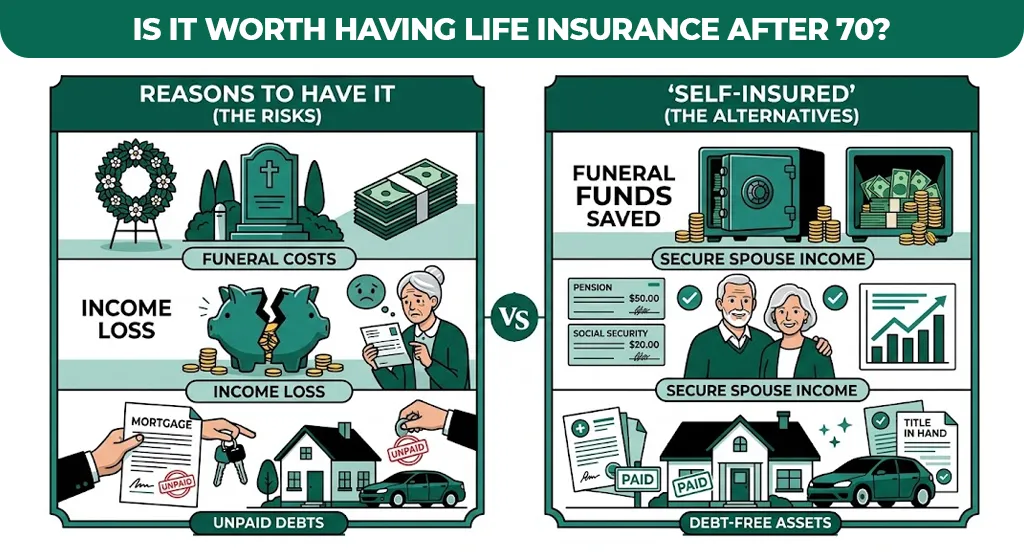
Life insurance after 70 is worth it when your death would leave someone with a bill they can’t easily pay. Common examples:
• Funeral and final expenses. The National Funeral Directors Association put the 2023 median cost of a funeral with viewing and burial at $8,300, before cemetery costs.
• Lost household income. When one spouse dies, the survivor typically keeps only the larger of the two Social Security benefits, and a pension may shrink or stop.
• Unpaid debts, such as a mortgage, a car loan, or a co-signed loan.
• A legacy for children, grandchildren, or a charity.
It’s usually not needed if you’re self-insured: your savings could cover your funeral and any debts, and your spouse would have enough income without you.
The cost of age: why buying early in your 70s saves money
Premiums rise faster after 70 because the chance of death rises faster. Social Security’s 2023 period life table puts a 70-year-old man’s chance of dying within a year at about 2.3%, rising to about 5.6% at 80.
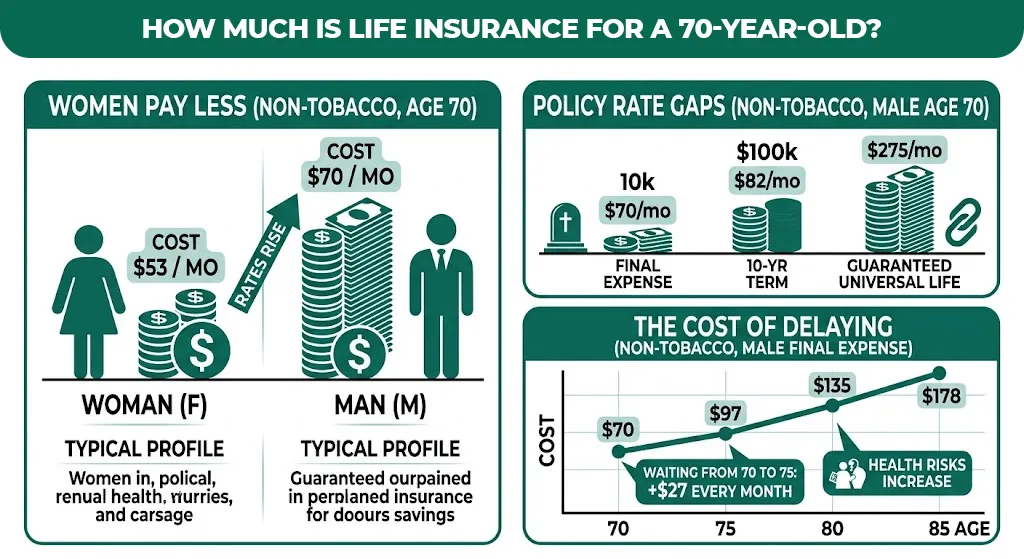
Choice Mutual’s published non-tobacco final expense rates show what waiting costs:
| $10,000 final expense | Buy at 70 | Buy at 75 | Buy at 80 |
| Woman (monthly) | $53 | $71 | $98 |
| Man (monthly) | $70 | $97 | $135 |
A man who waits from 70 to 75 pays $27 more every month for the rest of his life. Waiting also risks a new diagnosis that could limit you to guaranteed issue, with its two-year waiting period.
Core Policy Options for Seniors Over 70
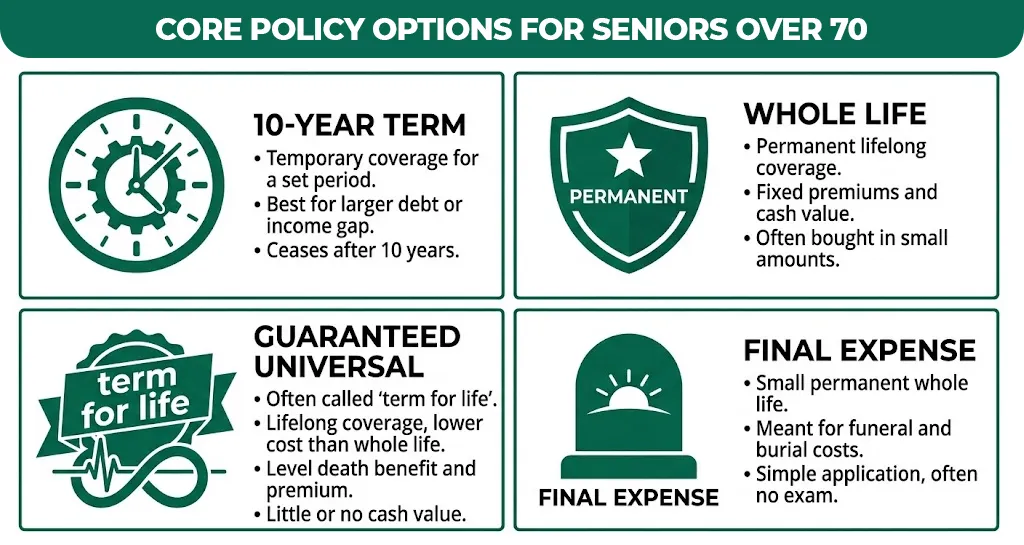
Seniors over 70 can choose from four main policy types: 10-year term, whole life, guaranteed universal life (GUL), and burial or final expense insurance (small whole life). Term is cheapest but temporary. GUL gives lifelong coverage at a lower price than whole life. Final expense covers funeral costs with the simplest approval.
Best term life insurance for seniors over 70
Term life insurance for seniors over 70 is mostly limited to 10-year terms, sometimes 15. Choice Mutual publishes 10-year term rates through age 80, while its 20-year rates stop at 65. Term makes sense if you need a larger amount for a set period: a mortgage that will be paid off, a spouse’s income gap until savings are secure, or a loan you co-signed.
| 10-year term, preferred non-tobacco | $100,000 (F / M) | $250,000 (F / M) |
| Age 70 | $56 / $82 | $108 / $169 |
| Age 75 | $98 / $138 | $224 / $329 |
| Age 80 | $198 / $252 | $486 / $621 |
The catch: if you outlive the term, coverage ends. A 70-year-old who buys 10-year term will need new coverage at 80, at much higher rates, if the need still exists.
Best whole life insurance for seniors over 70
Whole life insurance for seniors over 70 provides permanent coverage with fixed premiums and guaranteed cash value. It’s expensive in larger amounts: $100,000 of whole life costs about $506 (women) to $566 (men) a month at 70 at Choice Mutual’s published rates. That’s why most seniors over 70 buy whole life in small amounts as final expense coverage. See whole life insurance for how it works.
Guaranteed universal life insurance for seniors over 70
Guaranteed universal life (GUL) is often called “term for life.” It locks in a death benefit and a level premium to a chosen age, typically between 90 and 121, with little or no cash value. That makes it cheaper than whole life for the same lifelong death benefit.
NerdWallet’s published GUL averages (LifeStein.com data, preferred health, valid March 26, 2026) for $100,000:
| Issue age | Women (monthly) | Men (monthly) |
| 70 | $238.10 | $275.40 |
| 80 | $480.00 | $559.00 |
Compare that with 506–566 for $100,000 of whole life at 70. GUL suits seniors who want a guaranteed inheritance or estate liquidity without paying for cash value.
Note: GUL guarantees depend on paying the premium on time. A late or missed payment can cause the policy to lapse or shorten the guarantee. Set up automatic payments. Learn more in our guide to guaranteed universal life insurance.
Burial and final expense insurance for seniors over 70
Burial life insurance for seniors over 70 is small whole life coverage, usually $5,000 to $25,000, meant for funeral, burial or cremation, and final medical bills. Most policies are simplified issue: a short health questionnaire, no exam, and fixed premiums for life. At 70, $10,000 costs about $53 (women) to $70 (men) a month at Choice Mutual’s non-tobacco rates. See final expense insurance.
Master senior policy comparison matrix
| Policy type | Example max issue age | Typical coverage | Medical exam? | Waiting period | Ideal senior profile |
| 10-year term | About 80 (Choice Mutual rates) | 50,000–500,000+ | Often, or accelerated underwriting | None | Healthy, with a debt or income need for 10 years |
| Guaranteed universal life | 80+ with some carriers | $50,000+ | Usually | None | Healthy, wants lifelong coverage or an inheritance |
| Whole life (fully underwritten) | Varies by carrier | $25,000+ | Often | None | Wants cash value and fixed premiums |
| Simplified-issue final expense | 85 (Transamerica Immediate Solution); 89 (Aetna’s Accendo) | Up to 25,000–30,000 after 70, varies by carrier | No | None on level plans | Fair health; funeral planning |
| Guaranteed issue whole life | 85 (Mutual of Omaha, Corebridge) | 2,000–25,000 | No, and no health questions | 2-year graded benefit | Serious health conditions or prior declines |
No Medical Exam and No Waiting Period Options Over 70
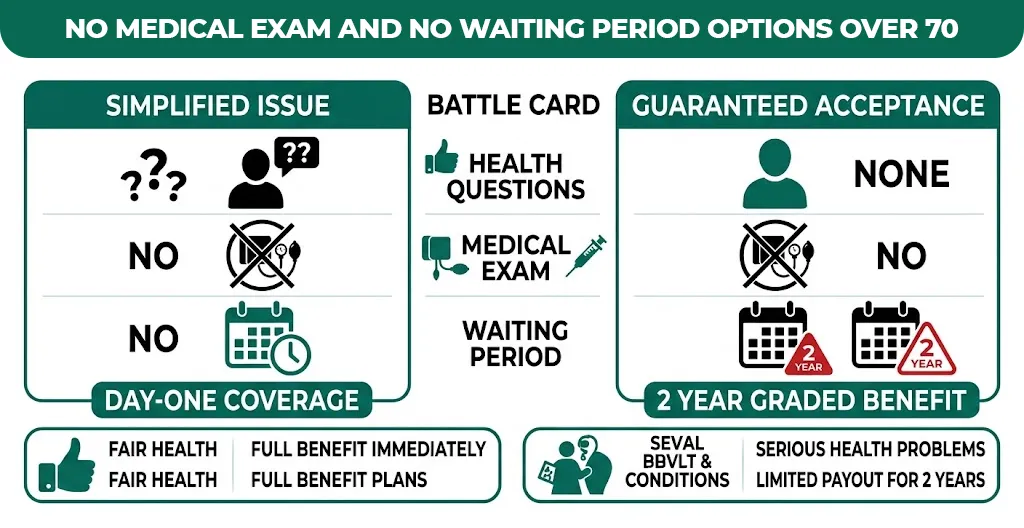
Most life insurance for seniors over 70 can be bought without a medical exam. Simplified-issue policies use a health questionnaire plus prescription and medical database checks, and pay the full benefit from day one if you’re approved for a level plan. Guaranteed-issue policies skip health questions entirely but limit the payout for the first two years.
Life insurance for seniors over 70 with no medical exam
No-exam life insurance for seniors over 70 works through simplified issue or accelerated underwriting. Instead of blood and urine tests, the insurer checks two main data sources:
• Prescription (Rx) history: the medications you’ve filled, which point to the conditions you’re treated for.
• MIB (Medical Information Bureau): a member-insurer database of coded information from past life and health insurance applications. It helps insurers catch undisclosed conditions or inconsistent answers.
You answer yes/no questions about recent diagnoses, hospital stays, and treatments. A decision can come quickly, sometimes during the call.
Term life insurance for seniors over 70 with no medical exam is less common, because larger amounts usually need fuller underwriting. Some carriers offer accelerated underwriting for healthy applicants, but no-exam limits are generally lower at older ages.
Life insurance for seniors over 70 with no waiting period
To get coverage with no waiting period, you need to qualify for a level-benefit simplified-issue policy. That usually means answering “no” to the carrier’s knockout questions. Depending on the carrier, these often ask about:
• A terminal illness, or being in hospice or a nursing home.
• Recent cancer treatment, heart attack, or stroke.
• Kidney dialysis, an organ transplant, or oxygen use.
• I need help with daily activities, such as bathing or dressing.
If you answer “yes” to some questions, many carriers offer a graded or modified simplified-issue plan, which may still cost less than the guaranteed issue.
Note: Answer every question honestly. During the two-year contestability period, an insurer can deny a claim if it finds an incorrect answer on the application.
Guaranteed acceptance vs. simplified issue
| Simplified issue | Guaranteed acceptance | |
| Health questions | Yes | None |
| Medical exam | No | No |
| Approval | Not guaranteed | Guaranteed within issue ages |
| Day-one coverage | Full, on level plans | Limited for 2 years |
| Typical cost | Lower | Higher |
| Best for | Most seniors in fair health | Serious health problems or prior declines |
The two-year graded death benefit is the trap to avoid if your health allows. Mutual of Omaha’s guaranteed whole life, for example, pays all premiums plus 10% if you die of natural causes in the first two years (accidental death pays in full). Colonial Penn’s guaranteed acceptance plan pays premiums plus 7% interest for non-accidental deaths in that period.
Price also matters. At 70, Mutual of Omaha’s guaranteed whole life costs about $64 (women) and $87 (men) a month for $10,000, versus $53 and $70 for simplified-issue final expense at Choice Mutual’s published rates. See our guides to guaranteed issue whole life insurance and the Colonial Penn $9.95 plan.
Real 2026 Rate Benchmarks: How Much Is Life Insurance for a 70-Year-Old?
A life insurance policy for a 70-year-old costs about $53 to $70 a month for $10,000 of final expense coverage, $56 to $82 for $100,000 of 10-year term, and about $238 to $275 for $100,000 of guaranteed universal life, based on published 2026 rates. Women pay less than men at every age, and every year of delay adds to the price.
Life insurance rates for seniors over 70: men vs. women
Men pay more because women live longer on average. Social Security’s 2023 period life table gives a 70-year-old woman about 16.8 more years of life expectancy, versus 14.7 for a man.
2026 monthly premiums: $10,000 and $25,000 whole life / burial insurance (non-tobacco)
| Age | $10,000 (F / M) | $25,000 (F / M) |
| 70 | $53 / $70 | $127 / $169 |
| 73 | Not published (between 70 and 75) | Not published |
| 75 | $71 / $97 | $172 / $238 |
| 78 | Not published (between 75 and 80) | Not published |
| 80 | $98 / $135 | $241 / $332 |
| 85 | $136 / $178 | $335 / $440 |
Note: Rates are from Choice Mutual’s published final expense tables (valid March 9, 2026), which list ages in five-year steps. Expect a 73-year-old to pay somewhere between the age-70 and age-75 rates. Choice Mutual’s separate whole life chart shows slightly different figures for men at 85 ($193 for $10,000), so get a quote for your exact age.
2026 monthly premiums: $100,000 and $250,000, 10-year term vs. GUL
| Age | 10-yr term $100k (F / M) | 10-yr term $250k (F / M) | GUL $100k (F / M) |
| 70 | $56 / $82 | $108 / $169 | $238 / $275 |
| 75 | $98 / $138 | $224 / $329 | Not published |
| 80 | $198 / $252 | $486 / $621 | $480 / $559 |
Note: Term rates are Choice Mutual’s preferred non-tobacco rates. GUL rates are NerdWallet’s published averages for preferred health (LifeStein.com data, March 2026); no published source we found lists $250,000 GUL rates or GUL rates at 73, 75, or 78. Get personalized quotes for those.
Should a 73-year-old have life insurance?
A 73-year-old should have life insurance if a spouse depends on their income, if they have debts that would pass to family, or if no savings are set aside for their funeral. If savings already cover all three, coverage is optional. At 73, the most common choice is a 10,000–25,000 final expense policy, which locks in a premium before the bigger jump at 75.
What is the best life insurance for seniors over 75?
After 75, the best option for most people is simplified-issue final expense whole life, because term and GUL get much more expensive and harder to qualify for. Coverage limits also drop: Transamerica’s Immediate Solution and Aetna’s Accendo policy, for example, cap coverage at $25,000 for applicants 76 and older. If you can’t pass health questions, guaranteed issue is available to 85 with Mutual of Omaha and Corebridge.
At what age is life insurance not worth it?
There’s no single age when life insurance stops being worth it. The real question is whether you’d pay in more than your policy pays out, and whether that’s an acceptable cost for the certainty it gives your family.
Using Choice Mutual’s $10,000 final expense rates and Social Security’s average life expectancy:
| Age at purchase | Monthly premium (M) | Years until premiums equal $10,000 | Average life expectancy (M) | Total premiums at life expectancy |
| 70 | $70 | 11.9 | 14.7 years | About $12,300 |
| 75 | $97 | 8.6 | 11.4 years | About $13,300 |
| 80 | $135 | 6.2 | 8.5 years | About $13,800 |
| 85 | $178 | 4.7 | 6.0 years | About $12,900 |
| Age at purchase | Monthly premium (F) | Years until premiums equal $10,000 | Average life expectancy (F) | Total premiums at life expectancy |
| 70 | $53 | 15.7 | 16.8 years | About $10,700 |
| 75 | $71 | 11.7 | 13.1 years | About $11,200 |
| 80 | $98 | 8.5 | 9.8 years | About $11,500 |
| 85 | $136 | 6.1 | 7.0 years | About $11,500 |
An average buyer pays somewhat more than the death benefit. Coverage is still worth it if you don’t have the cash set aside, or if you’d likely die before the break-even point because of your health. It’s usually not worth it if you already have enough savings to cover your funeral and debts and can leave that money untouched. In that case, keeping the money in savings may serve your family better.
Note: Life expectancy is an average. Many people live well past it, and many don’t reach it. The value of insurance is that your family gets the full benefit even if you die in year three, not year fifteen.
Top Life Insurance Companies for Seniors Over 70 and Buyer’s Blueprint
The best life insurance company for a senior over 70 is the one that approves you at the best rate for your age and health. Some carriers are strongest in simplified-issue final expense, others in guaranteed issue, and others in term for healthy applicants. Comparing several is the only reliable way to find the cheapest policy.
Evaluating top senior carriers
| Company | Strength for seniors over 70 | Published product details |
| Mutual of Omaha | Final expense and guaranteed issue | Guaranteed whole life: ages 45–85, 2,000–25,000; premiums plus 10% for natural-cause deaths in years 1–2 |
| Corebridge Financial (formerly AIG) | Guaranteed issue and simplified issue | Guaranteed issue whole life: ages 50–85, 5,000–25,000 |
| Transamerica | Simplified-issue final expense | Immediate Solution: issue ages 0–85; up to $30,000 at 66–75, $25,000 at 76–85 |
| Aetna (Accendo, Continental Life) | Simplified-issue final expense | Accendo: ages 40–89; up to $30,000 at 66–75, $25,000 at 76–89 |
| Banner Life | Term for healthy applicants | Known for competitive term pricing; check age limits for your term length |
Note: Product details come from carrier pages, brokerage summaries, and published reviews. They change, and availability varies by state. Check each insurer’s current financial strength rating with AM Best before you buy.
How to find the cheapest life insurance for seniors over 70
1. Buy only what you need. For funeral costs, 10,000–15,000 may be enough; you don’t need $25,000 if savings cover the rest.
2. Try a simplified issue first. It’s cheaper than guaranteed issue and pays in full from day one if you qualify.
3. Don’t smoke, or quit. Tobacco rates are significantly higher.
4. Compare several carriers. Each weighs health conditions differently, so the cheapest company for one 72-year-old may not be the cheapest for another.
5. Pay annually or by bank draft if the carrier offers a discount for it.
6. Buy sooner rather than later. Every year of age raises the premium, as the rate tables above show.
Step-by-step blueprint: compare rates via Insure Omni
1. Decide the goal -> Funeral? Spouse’s income? Inheritance? Debts?
2. Set the amount -> Add funeral costs, debts, and any legacy goal
3. List health facts -> Conditions, medications, tobacco, height, weight
4. Check eligibility -> Can you answer “no” to simplified-issue questions?
|
+– Yes -> Compare level-benefit final expense, term, or GUL
+– No -> Compare graded plans, then guaranteed issue
5. Compare quotes -> Day-one coverage, total premium, cost per $1,000
6. Apply and verify -> Keep any old policy until the new one is in force
For adult children buying for a parent, the parent must agree and sign the application, and the child can be the owner, payer, and beneficiary. See life insurance for seniors over 60 and best final expense insurance for seniors for related guides.
Conclusion
Life insurance for seniors over 70 is widely available, but the right policy depends on your goal and health. Final expense whole life covers funeral costs for most people. Term and GUL fit larger needs for healthy applicants. Guaranteed issue is a fallback, not a first choice. Because rates rise with every birthday, comparing now usually costs less than comparing later.
| If you are… | Look at… |
| 70–75, healthy, with a spouse who needs your income | 10-year term or GUL |
| 70–85 and mainly want funeral costs covered | Simplified-issue final expense, 10,000–25,000 |
| Wanting to leave a guaranteed inheritance | GUL to age 100 or 121 |
| Living with serious health conditions | Graded simplified issue, then guaranteed issue |
| Over 75 | Final expense; check the lower coverage caps |
| Already covered by savings | You may not need a new policy |
| An adult child buying for a parent | Final expense with the parent’s consent; you own and pay for it |
Lock In Your Rate with Insure Omni
After 70, the difference between the right policy and the wrong one can be hundreds of dollars a year and a two-year waiting period you didn’t need. Insure Omni‘s licensed agents help seniors and adult children compare final expense, term, and guaranteed issue options side by side.
• Start with our guides: final expense insurance and life insurance for senior citizens.
• Talk to Insure Omni senior specialists: call 855-994-4151 or book a consultation.
• Ask about first-day coverage: we’ll check whether you qualify for a level-benefit policy before you settle for a graded one.
Compare senior life insurance quotes at Insure Omni and lock in your rate before your next birthday raises it.
