


The TV ads make Colonial Penn sound simple: $9.95 a month, no health questions, guaranteed acceptance. What the ads don’t show is how much coverage that $9.95 actually buys, and the answer depends heavily on your age and gender.
A 50-year-old woman gets $2,000 of coverage per unit. An 80-year-old man gets $426 for the same $9.95. Most people need several units, and the monthly bill grows fast.
Quick answer: Each Colonial Penn unit costs $9.95 a month and buys $418 to $2,000 of coverage, depending on age and gender. You can buy up to 25 units (12 in New York). Coverage is limited for the first two years, so healthier seniors usually get more coverage for less with a simplified-issue policy.
Understanding Colonial Penn Life Insurance Rates
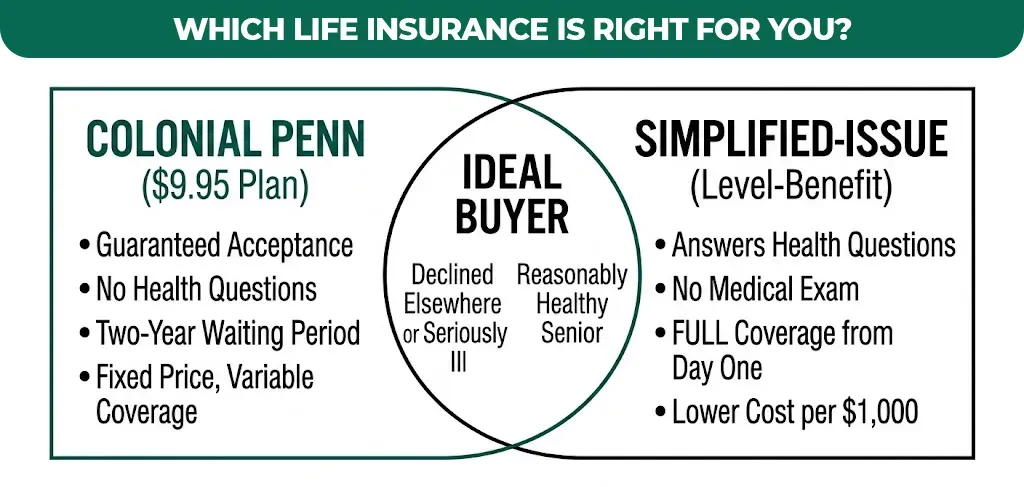
Colonial Penn’s $9.95 plan is guaranteed acceptance whole life insurance sold in “units.” Every unit costs the same $9.95 a month, but the coverage each unit buys depends on your age and gender when you apply. The older you are, the less coverage each unit buys.
The plan is formally called Colonial Penn Guaranteed Acceptance Whole Life. It’s issued by Colonial Penn Life Insurance Company, part of CNO Financial Group. Key features:
• No health questions or medical exam. If you’re within the issue ages (50–85 in most states), you’re accepted.
• Fixed premium. Once you buy, your premium never increases.
• Fixed benefit. Once you buy, your coverage doesn’t shrink as you age.
• Cash value. Starts building after the first year; you can borrow against it at 8% interest.
• Two-year graded benefit. If you die of natural causes in the first two years, your beneficiary gets the premiums you paid plus 7% interest, not the full benefit.
How much coverage do you actually get for $9.95 a month?
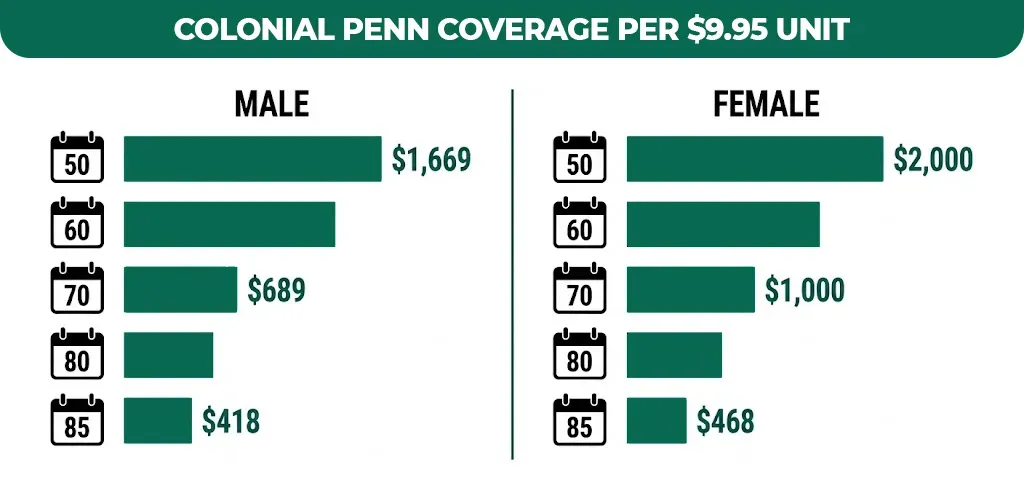
One $9.95 unit buys between $418 and $2,000 of coverage. At 50, a woman gets $2,000 and a man gets $1,669. By 70, that falls to $1,000 for a woman and $689 for a man. At 85, it’s $468 for a woman and $418 for a man.
The median funeral with viewing and burial cost $8,300 in 2023, according to the National Funeral Directors Association (NFDA), before cemetery costs. One unit alone covers only a small fraction of that at any age.
Why seniors must check the rate chart before buying
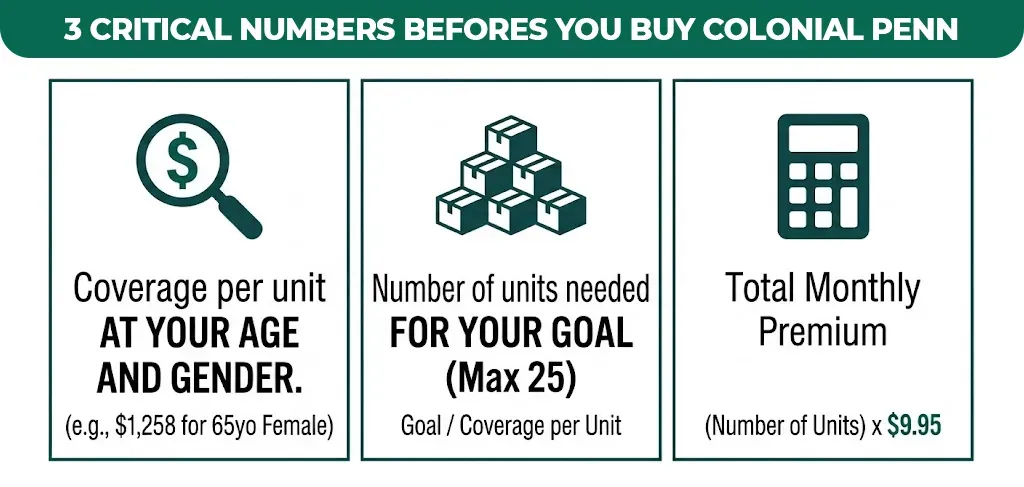
The advertised $9.95 is the price of one unit, not the price of a useful policy. Before you buy, check three numbers on the rate chart:
1. Coverage per unit at your age and gender.
2. How many units you need to reach your goal, and whether that’s under the 25-unit cap.
3. Your total monthly premium (units x $9.95).
Then compare that premium with what a first-day final expense policy would cost for the same coverage. For many applicants in reasonable health, the alternative is cheaper and pays in full from day one.
Note: Colonial Penn’s own site states that the benefit doesn’t decrease with age after you buy. The “decreasing” part applies only to new applicants: the older you are when you apply, the less coverage each $9.95 unit buys.
How the Colonial Penn $9.95 Plan Works: The Unit System Explained
The Colonial Penn unit system fixes the price and lets the coverage vary. You buy a number of units at $9.95 each per month, and each unit is worth a set dollar amount based on your age and gender at purchase. Total coverage is simply units multiplied by the per-unit value.
Fixed-coverage policies vs. fixed-price unit policies
| Fixed-coverage policy (most final expense) | Fixed-price unit policy (Colonial Penn $9.95 plan) | |
| You choose | A coverage amount, such as $10,000 | A number of units |
| Insurer sets | The premium for your age and health | The coverage per unit for your age and gender |
| Older applicant gets | The same coverage, at a higher premium | Less coverage, at the same per-unit price |
| Easy to compare? | Yes: same coverage, compare price | No: you must convert units to dollars first |
The unit model makes the price look the same for everyone. In reality, a unit is worth much less to an 80-year-old than to a 50-year-old, which means the real cost per dollar of coverage rises steeply with age.
The math: how age and gender set the unit value
Use these two formulas:
Total coverage = Number of units x Coverage per unit (for your age and gender)
Monthly premium = Number of units x $9.95
Example: 65-year-old man buying 10 units
Coverage per unit at 65 (male): $896
Total coverage: 10 x $896 = $8,960
Monthly premium: 10 x $9.95 = $99.50
Women get more coverage per unit than men at every age, because women live longer on average.
Maximum unit limits and monthly cost
Colonial Penn sells up to 25 units per person in most states, or 12 units in New York. At 25 units, the premium tops out at $248.75 a month.
Maximum premium (most states): 25 x $9.95 = $248.75/month
Maximum premium (New York): 12 x $9.95 = $119.40/month
Even at the maximum, older applicants can’t buy much coverage. A man who applies at 80 can buy at most $10,650.
Complete Colonial Penn $9.95 plan rate chart by age and gender
The chart below shows coverage per $9.95 unit, plus the maximum coverage at 25 units (most states) and 12 units (New York).
| Age | Male: per unit | Female: per unit | Male: 25 units ($248.75/mo) | Female: 25 units ($248.75/mo) | Male: 12 units, NY ($119.40/mo) | Female: 12 units, NY ($119.40/mo) |
| 50 | $1,669 | $2,000 | $41,725 | $50,000 | $20,028 | $24,000 |
| 55 | $1,420 | $1,761 | $35,500 | $44,025 | $17,040 | $21,132 |
| 60 | $1,167 | $1,515 | $29,175 | $37,875 | $14,004 | $18,180 |
| 65 | $896 | $1,258 | $22,400 | $31,450 | $10,752 | $15,096 |
| 70 | $689 | $1,000 | $17,225 | $25,000 | $8,268 | $12,000 |
| 75 | $549 | $762 | $13,725 | $19,050 | $6,588 | $9,144 |
| 80 | $426 | $608 | $10,650 | $15,200 | Not issued in NY | Not issued in NY |
| 85 | $418 | $468 | $10,450 | $11,700 | Not issued in NY | Not issued in NY |
Note: Per-unit values come from Choice Mutual’s published Colonial Penn chart (retrieved March 9, 2026). Issue ages vary by state: 50–85 in most states, 50–75 in New York, Minnesota, and Missouri, and 56–85 in Pennsylvania, for example. Confirm your exact figures with a quote.
The pattern is clear: per-unit coverage for a man drops by about 75% between ages 50 and 85, while the price per unit stays at $9.95.
Real Cost Breakdowns: $10,000, $25,000, and $50,000 of Coverage
To reach a set amount of coverage with Colonial Penn, divide your target by the per-unit value and round up. A 70-year-old man needs 15 units ($149.25 a month) for $10,000. The same man can’t reach $25,000 or $50,000 at all, because he would need more than 25 units.
Units needed = Target coverage / Coverage per unit (round up)
Monthly premium = Units needed x $9.95
Colonial Penn monthly cost by coverage amount
| Age | $10,000: Male | $10,000: Female | $25,000: Male | $25,000: Female | $50,000: Male | $50,000: Female |
| 50 | 6 units, $59.70 | 5 units, $49.75 | 15 units, $149.25 | 13 units, $129.35 | Over cap (max $41,725) | 25 units, $248.75 |
| 60 | 9 units, $89.55 | 7 units, $69.65 | 22 units, $218.90 | 17 units, $169.15 | Over cap (max $29,175) | Over cap (max $37,875) |
| 70 | 15 units, $149.25 | 10 units, $99.50 | Over cap (max $17,225) | 25 units, $248.75 | Over cap | Over cap |
| 80 | 24 units, $238.80 | 17 units, $169.15 | Over cap (max $10,650) | Over cap (max $15,200) | Over cap | Over cap |
Rounding up means you’ll usually get slightly more than the target. For example, 9 units for a 60-year-old man buys $10,503.
How much is a $25,000 whole life policy from Colonial Penn vs. competitors?
A $25,000 Colonial Penn policy costs $129.35 to $248.75 a month for the ages where it’s available. A simplified-issue final expense policy for the same $25,000 costs about $55 to $169 a month at those ages, based on Choice Mutual’s published non-tobacco rates, and pays the full benefit from day one.
$25,000 coverage: Colonial Penn vs. level-benefit final expense (monthly)
| Age | Colonial Penn (M / F) | Level final expense, non-tobacco (M / F) | Difference for women |
| 50 | $149.25 / $129.35 | $71 / $55 | $74.35 more with Colonial Penn |
| 60 | $218.90 / $169.15 | $103 / $76 | $93.15 more |
| 70 | Not available / $248.75 | $169 / $127 | $121.75 more |
| 80 | Not available / Not available | $332 / $241 | — |
How much is a $50,000 life insurance policy from Colonial Penn?
A $50,000 Colonial Penn policy is only possible for a woman who applies at age 50. She would need the maximum 25 units, at $248.75 a month. Every man, and every woman over 50, hits the 25-unit cap before reaching $50,000.
If you need $50,000, look at simplified-issue whole life or term insurance instead. Aetna’s Accendo final expense policy, for example, issues up to $50,000 at ages 40–55.
$10,000 coverage: Colonial Penn vs. other options
| Age | Colonial Penn (M / F) | Level final expense (M / F) | Mutual of Omaha guaranteed whole life (M / F) |
| 50 | $59.70 / $49.75 | $31 / $24 | — |
| 60 | $89.55 / $69.65 | $43 / $33 | — |
| 70 | $149.25 / $99.50 | $70 / $53 | $87 / $64 |
| 80 | $238.80 / $169.15 | $135 / $98 | — |
Note: The level final expense figures are Choice Mutual’s published non-tobacco rates (valid March 9, 2026). They require answering health questions, and your rate may be higher. The Mutual of Omaha figures are for a guaranteed issue policy, which, like Colonial Penn, asks no health questions and has a two-year graded benefit. That makes it the most direct comparison for people who can’t qualify for simplified issue.
The Downsides and Hidden Catch of Colonial Penn Life Insurance
The biggest downsides of Colonial Penn’s $9.95 plan are the two-year graded death benefit, the high cost per $1,000 of coverage, and the low maximum coverage for older applicants. None of these make it a bad product for everyone. They do make it a poor value for anyone healthy enough to qualify for a policy that asks health questions.
What’s the downside of Colonial Penn life insurance? The two-year graded benefit
If you die from natural causes in the first two years, Colonial Penn pays your beneficiary the premiums you paid plus 7% interest, compounded annually, instead of the full benefit. After two years, the full benefit is paid. Colonial Penn’s own description calls it “a graded death benefit contract with a limited death benefit payment in the first 2 years.” Accidental deaths are not subject to the reduced payout, according to ValuePenguin.
Example: a 65-year-old man with 10 units
Full death benefit: 10 x $896 = $8,960
Premiums paid if he dies at month 18: 18 x $99.50 = $1,791
Graded payout: about $1,791 plus 7% interest, roughly $1,900
Shortfall vs. full benefit: about $7,000
The graded period protects the insurer from people who buy coverage knowing they’re very ill. It’s standard for guaranteed acceptance policies. The problem is that many buyers could qualify for a policy without that waiting period.
High cost per $1,000 of coverage
Cost per $1,000 lets you compare policies of different sizes. Colonial Penn’s cost per $1,000 rises from about $5 to $24 a month depending on age and gender. Level-benefit final expense costs roughly half as much at most ages.
Monthly cost per $1,000 of coverage
| Age | Colonial Penn (M / F) | Level final expense, $10k policy (M / F) |
| 50 | $5.96 / $4.97 | $3.10 / $2.40 |
| 60 | $8.53 / $6.57 | $4.30 / $3.30 |
| 70 | $14.44 / $9.95 | $7.00 / $5.30 |
| 80 | $23.36 / $16.37 | $13.50 / $9.80 |
Paying in more than the policy pays out
Because per-unit coverage is so small at older ages, it doesn’t take long for total premiums to exceed the death benefit:
| Applies at age (male) | Coverage per unit | Months of $9.95 premiums to equal the benefit |
| 65 | $896 | About 90 months (7.5 years) |
| 75 | $549 | About 55 months (4.6 years) |
| 80 | $426 | About 43 months (3.6 years) |
A 75-year-old man has an average life expectancy of about 11.4 more years, according to the Social Security Administration’s 2023 period life table. If he lives that long, he’ll pay roughly $1,360 per unit for $549 of coverage.
Note: Paying more in premiums than the death benefit isn’t unique to Colonial Penn. Any small permanent policy bought late in life can do this. The difference is how quickly it happens, and that the plan’s guaranteed acceptance comes at a premium that healthier buyers don’t need to pay.
Why buying guaranteed acceptance when you’re healthy is a mistake
Guaranteed acceptance is designed for people who can’t qualify anywhere else. If you’re in reasonable health, buying it means you:
• Pay more per dollar of coverage than a simplified-issue policy would charge.
• Accept a two-year waiting period you might not need.
• Get less total coverage, because of the 25-unit cap.
Before choosing Colonial Penn, answer a simplified-issue health questionnaire with an independent agent. If you’re approved, you’ll typically get full coverage from day one for less. If you’re declined, a guaranteed acceptance policy is still there as a backup.
| Pros of the Colonial Penn $9.95 plan | Cons of the Colonial Penn $9.95 plan |
| Guaranteed acceptance at ages 50–85 (most states) | Two-year graded death benefit |
| No medical exam or health questions | High cost per $1,000 of coverage |
| Premium never increases | Maximum 25 units limits total coverage |
| Coverage never decreases after purchase | Unit pricing makes comparison harder |
| Builds cash value after year one | Policy loans charge 8% interest |
| Backed by CNO Financial Group | Older buyers can pay in more than the benefit within a few years |
Alternatives for Seniors: Level-Benefit Final Expense vs. Guaranteed Issue
The main alternative to Colonial Penn is simplified-issue final expense insurance: whole life coverage that asks a few health questions, has no exam, and pays the full benefit from day one. If you can’t qualify for that, other guaranteed issue policies are the direct competitors, and their prices are worth comparing too.
Simplified-issue whole life: full coverage from day one
Simplified-issue final expense insurance asks a short list of yes/no health questions and checks prescription and medical databases. There’s no exam. If you’re approved for a level-benefit plan, your beneficiaries get the full benefit even if you die in the first month.
Depending on the carrier, you may still qualify with conditions such as:
• High blood pressure or cholesterol controlled with medication.
• Type 2 diabetes without serious complications.
• A past heart attack or cancer that’s several years behind you (rules vary by carrier).
If you have a recent serious diagnosis, many carriers offer a graded or modified plan, which may still beat guaranteed acceptance on price.
Colonial Penn vs. top senior carriers
| Carrier and policy | Underwriting | Issue ages | Coverage | First two years |
| Colonial Penn Guaranteed Acceptance Whole Life | No health questions | 50–85 (most states) | Up to 25 units (10,450–50,000 max, by age and gender) | Premiums plus 7% interest for non-accidental death |
| Mutual of Omaha Guaranteed Whole Life | No health questions | 45–85 | 2,000–25,000 | Premiums plus 10% for natural causes; accidental death pays in full |
| Corebridge Financial Guaranteed Issue Whole Life | No health questions | 50–85 | 5,000–25,000 | Graded (check the contract) |
| Transamerica Immediate Solution | Health questions | 0–85 | Up to $50,000 (ages 0–55), down to $25,000 (76–85) | No graded limit listed |
| Transamerica Easy Solution | Simplified | 18–80 | Up to $25,000 | Up to 110% of premiums for non-accidental death |
Note: Product details are from carrier pages, a brokerage summary, and published reviews (see Sources). Availability varies by state. Check each insurer’s current financial strength rating with AM Best before buying.
For the deeper review of the company itself, see our guide to the Colonial Penn $9.95 plan. For other options, read best final expense insurance for seniors and guaranteed issue whole life insurance.
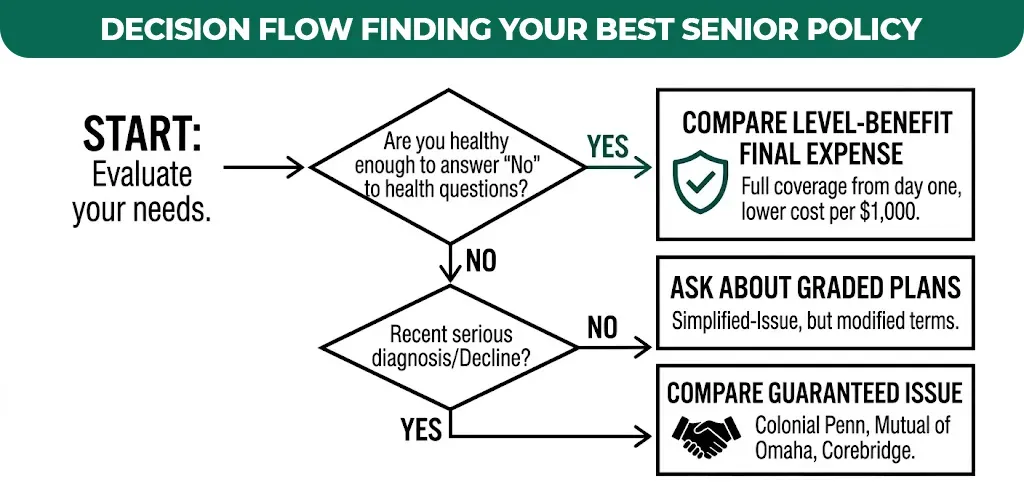
Decision flow: which policy should you look at?
Can you answer “no” to most simplified-issue health questions?
+– Yes –> Compare level-benefit final expense quotes
(full coverage from day one, lower cost per $1,000)
+– No –> Do you have a serious condition diagnosed in the last 2 years, or have you been declined?
+– No –> Ask about graded/modified simplified-issue plans
+– Yes –> Compare guaranteed issue policies side by side:
Colonial Penn, Mutual of Omaha, Corebridge
(convert Colonial Penn units to dollars first)
Step-by-step: compare senior life insurance rates via Insure Omni
1. Set your target. Estimate funeral, burial or cremation, and final bills. See our whole life insurance rates by age chart for benchmarks.
2. Convert any Colonial Penn quote to dollars. Multiply units by the per-unit value for your age, then divide the premium by the coverage to get cost per $1,000.
3. List your health details honestly: conditions, medications, tobacco use, height, and weight.
4. Talk to an Insure Omni licensed agent, who can check simplified-issue and guaranteed-issue options from several carriers.
5. Compare day-one coverage, total premium, and cost per $1,000, not just the monthly price.
6. Keep any existing policy until the new one is approved and in force.
Conclusion
The Colonial Penn life insurance rate chart by age tells the real story behind the $9.95 price: each unit buys $418 to $2,000 of coverage, the most anyone can buy is 25 units, and the full benefit isn’t paid for natural-cause deaths in the first two years. That makes the plan a reasonable last resort for people who can’t qualify elsewhere, and an expensive choice for everyone else.
Before you buy, convert units to dollars, check your cost per $1,000, and get at least one simplified-issue quote for comparison.
| Your situation | What to consider |
| Healthy or managing common conditions, age 50–80 | Level-benefit final expense: full coverage from day one, lower cost |
| Need $25,000 or more after age 70 | Simplified-issue whole life; Colonial Penn likely can’t reach it |
| Need $50,000 | Simplified-issue whole life or term; Colonial Penn only reaches it for a woman at 50 |
| Declined elsewhere or seriously ill | Compare guaranteed issue: Colonial Penn, Mutual of Omaha, Corebridge |
| Already own Colonial Penn units | Keep them until any replacement is approved; past the two-year mark, your full benefit is in force |
| Buying for a parent | Compare cost per $1,000 and the total premiums your family will pay over time |
Find the Best Senior Coverage with Insure Omni
A $9.95 TV offer is easy to buy, but it isn’t always the best value. Insure Omni‘s licensed agents help seniors and their families compare final expense and whole life options side by side, so you can see the real cost per $1,000 and whether you qualify for full coverage from day one.
• Compare your options: start with our final expense insurance and whole life insurance pages.
• Talk to Insure Omni financial specialists: call 855-994-4151 or book a consultation.
• Bring your Colonial Penn quote: we’ll help you convert units to dollars and compare it against level-benefit and guaranteed issue policies.
Compare senior life insurance quotes at Insure Omni and make sure every dollar you pay buys as much protection as possible.
