


A $100,000 dividend-paying whole life policy bought at age 30 is illustrated to build about $24,000 of cash value after 20 years and nearly $49,000 after 30, based on Choice Mutual’s 2026 sample illustrations.
Quick answer: A cash value life insurance policy is permanent coverage, such as whole, universal, or indexed universal life, that combines a death benefit with a savings account that grows tax-deferred. You can borrow against it, withdraw from it, or surrender the policy for it. Term life insurance has no cash value.
What Is a Cash Value Life Insurance Policy?
A cash value life insurance policy is permanent life insurance with a built-in savings account that grows tax-deferred while you’re alive. The cash value is separate from the death benefit, and you can tap it through policy loans, withdrawals, or by surrendering the policy.
How cash value functions
Every premium is split. Part pays the insurer’s mortality charge (the cost of insurance) and administrative costs, and the rest goes into the cash value account, where it earns guaranteed interest, dividends, or index-linked credits depending on the policy type. In the early years, most of the premium goes to costs and commissions, so cash value builds slowly at first.

How premiums build cash value
Which life insurance policies have cash value?
|
Policy type |
Has cash value? |
How it grows |
Guarantees |
|
Term life |
No |
Not applicable |
Death benefit for the term only |
|
Whole life |
Yes |
Guaranteed schedule, plus dividends if participating |
Premium, cash value, and death benefit |
|
Universal life (UL) |
Yes |
Declared interest rate, with a minimum |
Varies; depends on funding |
|
Indexed universal life (IUL) |
Yes |
Linked to a market index with a cap and a floor (often 0%) |
Floor protects against index losses, but charges still apply |
|
Variable universal life (VUL) |
Yes |
Invested in market subaccounts |
No guaranteed cash value; can lose money |
|
Guaranteed universal life (GUL) |
Minimal |
Little or none by design |
Death benefit, if premiums are paid on time |
Insure Omni explains the main permanent options in its guides to whole life insurance, universal life vs. whole life, and indexed universal life insurance.

Cash Value Growth Mechanics Across Policy Types
Cash value grows differently in each type of permanent policy. Whole life follows a guaranteed schedule and may add dividends; universal life credits a declared rate; indexed universal life links growth to a market index within a cap and a floor. The more a policy guarantees, the more predictable, and usually slower, its growth.
Whole life insurance cash value
A whole life insurance policy with cash value grows on a contractual schedule that the insurer guarantees, reaching the full face amount at the policy’s maturity age (often 121). Participating policies from mutual insurers can also pay dividends, which aren’t guaranteed but can buy paid-up additions that accelerate growth. In Choice Mutual’s 2026 sample illustrations, a $100,000 policy for a 30-year-old man shows about $24,300 of cash value at year 20 with dividends, compared with about $16,600 on a non-dividend policy.
Universal life and indexed universal life (IUL)
Universal life insurance policy cash value is credited with an interest rate the insurer declares, subject to a guaranteed minimum, after monthly cost of insurance and fees are deducted. IUL credits interest based on an index such as the S&P 500, subject to a cap on gains and a floor, often 0%, so the account isn’t credited with negative index returns. Charges still come out every month, so poor index years can still shrink the cash value. Insure Omni compares the flexible-premium approach in flexible premium life insurance.
Which type of life insurance policy generates immediate cash value?
No standard policy has meaningful cash value on day one, because early premiums cover acquisition costs. The designs that build cash value fastest are:
- Single premium whole life: one large payment creates substantial cash value immediately, though the policy is usually a modified endowment contract (MEC).
- Paid-up additions (PUA) riders: extra premium buys small blocks of paid-up coverage that have cash value right away.
- High early cash value designs: policies with reduced commissions or low surrender charges, sometimes sold for business or executive use.
- Overfunded universal or whole life: paying near the IRS limit without crossing into MEC status.
Insure Omni covers these strategies in single premium whole life insurance and overfunded whole life insurance.
How to Calculate the Cash Value of a Life Insurance Policy
The cash value shown on your statement is the gross amount in the policy. What you’d actually receive if you cancel, the net cash surrender value, is that amount minus any surrender charges and any outstanding policy loans with interest.
Step-by-step calculation formula
- Find the accumulated cash value on your latest annual statement or in-force illustration.
- Subtract surrender charges using the schedule in your contract for the current policy year.
- Subtract outstanding loans and accrued interest.
- The result is your net cash surrender value, the amount the insurer would pay if you cancel today.
Example (illustrative): A man who bought a $100,000 participating whole life policy at 40 is in policy year 20. His illustrated cash value is $35,727, his surrender charge period has ended, and he has a $5,000 policy loan with $300 of accrued interest.
|
Item |
Amount |
|
Accumulated cash value |
$35,727 |
|
Surrender charge |
$0 |
|
Outstanding loan plus interest |
−$5,300 |
|
Net cash surrender value |
$30,427 |
The cash value figure comes from Choice Mutual’s 2026 illustration; the loan amounts are hypothetical.

Understanding surrender charges
Surrender charges let the insurer recover its upfront costs if you cancel early. They’re highest in the first policy years and typically decline each year until they disappear, often after 10 to 15 years, per NerdWallet. Universal life policies usually show the schedule as a dollar amount per year; whole life policies often build the charge into a lower guaranteed cash value in early years. Insure Omni’s cash surrender value guide walks through more examples.
Paid-up life insurance policy cash value
A paid-up policy needs no more premiums but stays in force and keeps growing. Some whole life policies are designed to be paid up after a set period, such as 10 or 20 years or at age 65. If you stop paying on a regular whole life policy, the reduced paid-up option uses your cash value to buy a smaller, fully paid policy that continues to earn guaranteed growth and any dividends. See Insure Omni’s reduced paid-up insurance guide for how the conversion works.
Real-World Growth Examples: $100k, $500k, and $1 Million Policies
In 2026 sample illustrations, a dividend-paying whole life policy bought at 30 builds cash value of roughly half its face amount after 30 years: about $49,000 on $100,000, $244,000 on $500,000, and $489,000 on $1 million. Older buyers pay higher premiums and build cash value faster in dollar terms.
Key drivers of growth
- Policy design: participating whole life, non-participating whole life, UL, and IUL all credit growth differently.
- Age at issue: older buyers pay more per $1,000 of coverage, so more money flows into cash value.
- Premium funding level: paying more than the minimum, or adding PUA riders, speeds growth.
- Dividends and crediting rates: dividend scales and IUL caps aren’t guaranteed and can change.

Cash value vs. premiums paid, $100,000 whole life bought at 30
In this example, dividend-paying cash value passes total premiums paid between years 10 and 15; the non-dividend policy only roughly catches up around year 30.

Projected whole life cash value by face amount and issue age
|
Face amount |
Issue age |
Annual premium |
Cash value, year 10 |
Cash value, year 20 |
Cash value, year 30 |
Total premiums by year 30 |
|
$100,000 |
30 |
$1,013 |
$8,259 |
$24,272 |
$48,894 |
$30,390 |
|
$100,000 |
40 |
$1,473 |
$12,603 |
$35,727 |
$69,926 |
$44,190 |
|
$100,000 |
50 |
$2,229 |
$19,348 |
$52,740 |
$98,335 |
$66,870 |
|
$500,000 |
30 |
$4,711 |
$41,297 |
$121,362 |
$244,470 |
$141,330 |
|
$500,000 |
40 |
$7,000 |
$63,015 |
$178,633 |
$349,632 |
$210,000 |
|
$500,000 |
50 |
$10,738 |
$96,738 |
$263,702 |
$491,673 |
$322,140 |
|
$1,000,000 |
30 |
$9,347 |
$82,593 |
$242,723 |
$488,940 |
$280,410 |
|
$1,000,000 |
40 |
$13,925 |
$126,030 |
$357,265 |
$699,264 |
$417,750 |
|
$1,000,000 |
50 |
$21,401 |
$193,475 |
$527,404 |
$983,346 |
$642,030 |
Source: Choice Mutual participating whole life illustrations for men at a non-tobacco preferred rating, valid as of March 9, 2026; women’s premiums and cash values are slightly lower. Cash values include non-guaranteed dividends; total premiums are our arithmetic.
Note: These are illustrations, not guarantees. Your policy’s guaranteed column will show lower values, and actual dividends depend on the insurer’s future results. Always ask for both guaranteed and non-guaranteed figures.
Cash value feature comparison
|
Feature |
Term |
Whole life |
Universal life |
IUL |
|
Cash value |
None |
Guaranteed schedule plus possible dividends |
Declared interest rate |
Index-linked, with cap and floor |
|
Premium flexibility |
Fixed for the term |
Fixed |
Flexible within limits |
Flexible within limits |
|
Guarantees |
Death benefit for the term |
Premium, cash value, death benefit |
Minimum rate; benefit depends on funding |
0% floor on index credits; benefit depends on funding |
|
Growth potential |
None |
Low to moderate |
Low to moderate |
Moderate, capped |
|
Lapse risk |
Ends at term |
Low if premiums paid |
Higher if underfunded |
Higher if underfunded |
|
Relative cost |
Lowest |
Highest |
Moderate |
Moderate to high |
Insure Omni’s whole life insurance cost guide shows current premium ranges.
3 Ways to Access Your Life Insurance Cash Value While Alive
You can borrow against your cash value, withdraw part of it, or surrender the policy for all of it. Loans and withdrawals keep coverage in force with a smaller death benefit; surrender ends coverage and can trigger income tax on any gain.
|
Feature |
Policy loan |
Partial withdrawal |
Full surrender |
|
Coverage continues? |
Yes |
Yes |
No |
|
Effect on death benefit |
Reduced by unpaid loan and interest |
Reduced, often dollar for dollar or more |
Ends |
|
Repayment required? |
No, but interest accrues |
No |
Not applicable |
|
Tax (non-MEC policy) |
Generally none while the policy stays in force |
Tax-free up to premiums paid (cost basis) |
Gain above cost basis taxed as ordinary income |
|
Best for |
Short-term cash needs, retirement income |
Taking back premiums without debt |
Coverage no longer needed |
Method 1: Borrowing from cash value
A policy loan uses your cash value as collateral, so there’s no credit check and no repayment schedule. The insurer charges interest at a fixed or variable rate set in your contract; unpaid interest is added to the loan. If you die with a loan outstanding, the insurer subtracts it from the death benefit. Insure Omni explains the steps in can you borrow against a life insurance policy.
Note: The biggest risk is a growing loan. If the loan and interest grow larger than the cash value, the policy can lapse, and any loan amount above your premiums paid can become taxable income in that year.
Method 2: Partial cash withdrawals
You can withdraw cash value from a life insurance policy without canceling it, mainly in universal life policies, or in whole life by surrendering paid-up additions or dividends. For a policy that isn’t a modified endowment contract, withdrawals are taxed first-in, first-out (FIFO): the first dollars out are a tax-free return of your premiums, and only amounts above your cost basis are taxable. Withdrawals permanently reduce the death benefit.
Method 3: Surrendering the policy for cash value
Surrendering cancels the policy and pays your net cash surrender value. If that payment is more than the premiums you paid, the difference is taxable as ordinary income, and the insurer reports it on Form 1099-R. Consider alternatives first: a reduced paid-up policy, a 1035 exchange into another policy or annuity, or, for older policyholders, a life settlement. Insure Omni compares the options in how to cash out a life insurance policy.

Is the Cash Value of Life Insurance Taxable? IRS Rules Explained
Cash value grows tax-deferred, so you owe nothing while it accumulates. Tax applies only when you take out more than your cost basis, which is generally the premiums you’ve paid, through a withdrawal or surrender, or when a policy with a loan lapses. The death benefit itself is generally income-tax-free to beneficiaries.
The cost basis rule
Your cost basis is the total premiums you’ve paid, minus any premiums refunded, dividends received in cash, and any untaxed amounts you’ve already taken out. IRS Publication 525 explains that if you surrender a policy for cash, you include in income the proceeds that exceed your cost.
Example: A man who bought $100,000 of participating whole life at 30 surrenders it in year 30. His illustrated cash value is $48,894, and he has paid $30,390 in premiums, with dividends used to buy paid-up additions rather than taken in cash. His taxable gain is about $18,504, taxed as ordinary income, not capital gains.
Tax-free policy loans, and the lapse trap
A policy that meets the IRC §7702 definition of life insurance lets you borrow against cash value without tax, because a loan isn’t income. The trap comes if the policy lapses or is surrendered with a loan outstanding: the loan is treated as paid off with policy proceeds, and any amount above your cost basis becomes taxable income in that year, even though you receive little or no cash.
Modified endowment contract (MEC) warnings
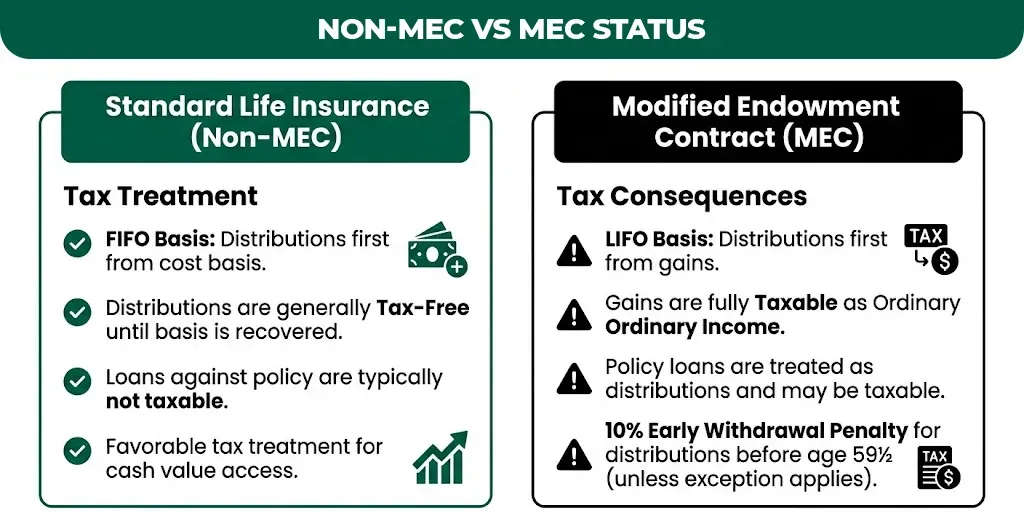
If you pay premiums faster than the federal 7-pay test allows under IRC §7702A, the policy becomes a modified endowment contract. A MEC keeps its tax-free death benefit, but loans and withdrawals are taxed gain-first (LIFO), and taxable amounts taken before age 59½ generally face an extra 10% penalty. MEC status is permanent once triggered.
|
Action |
Non-MEC policy |
MEC |
|
Withdrawal |
Basis first, tax-free up to premiums paid (FIFO) |
Gain first, taxable (LIFO) |
|
Policy loan |
Not taxed while in force |
Taxed like a withdrawal to the extent of gain |
|
10% penalty before 59½ |
No |
Yes, on taxable amounts |
|
Death benefit |
Generally tax-free |
Generally tax-free |
Insure Omni’s guide to cash surrender value covers how the IRS taxes gains on surrender.
Cash Value Life Insurance Policy Pros and Cons
A cash value policy makes sense when you need lifelong coverage and value guaranteed, tax-advantaged savings alongside it. For most families who only need protection during working years, term life plus separate investing costs far less.
Pros
- Tax-deferred growth on cash value, with no annual tax on gains.
- Tax-free access through policy loans and withdrawals up to basis, when structured correctly.
- Lifelong coverage with a guaranteed death benefit on whole life.
- Guaranteed growth on whole life, plus potential dividends.
- Asset protection: many states shield some or all cash value from creditors; rules vary by state.
- Forced savings for people who benefit from a disciplined monthly commitment.
Cons
- Much higher premiums than term for the same death benefit; a $500,000 whole life policy for a 40-year-old man costs about $7,000 a year in Choice Mutual’s illustration.
- Slow early growth: cash value usually trails premiums paid for the first 10 to 15 years or more.
- Fees and surrender charges reduce returns and penalize early exits.
- Complexity: loans, MEC rules, and lapse risk require ongoing attention.
- Lower long-term returns than a diversified stock portfolio for most buyers.
Who needs a cash value policy?
|
Profile |
Why it can fit |
|
High earners who max out retirement accounts |
Extra tax-deferred savings with tax-free loan access |
|
Estate planning and wealth transfer |
Permanent, tax-free death benefit for heirs or estate taxes |
|
Parents of a lifelong dependent |
Coverage that never expires |
|
Business owners |
Funding buy-sell agreements or key person coverage with a cash asset |
|
Conservative savers |
Guaranteed growth without market losses |
If you only need coverage until the kids are grown or the mortgage is paid, term is usually the better buy. Insure Omni compares the two in term vs. whole life insurance and weighs the decision in is whole life insurance worth it.
Conclusion:
A cash value life insurance policy gives you two things at once: a death benefit that lasts for life and a tax-deferred account you can use while you’re alive. It works best when you need permanent coverage, can afford the premium for decades, and understand how loans, withdrawals, and surrenders are taxed. Always compare the guaranteed and illustrated columns before you buy.
|
If your main goal is… |
Consider |
|
Guaranteed growth and fixed premiums |
Participating whole life |
|
Lower cost with lifelong coverage and little savings |
Guaranteed universal life |
|
Flexible premiums with interest-based growth |
Universal life |
|
Market-linked growth with downside protection |
Indexed universal life, well funded |
|
Fast early cash value |
Single premium or PUA-heavy whole life (watch MEC limits) |
|
Coverage only while the kids are young |
Term life |
Compare Cash Value Policies With Insure Omni
Insure Omni connects families across the United States with licensed agents who explain coverage options in plain language and help find a plan that fits the budget.
- Licensed agents who compare options based on your needs.
- Whole life and other permanent policies that build cash value you can borrow against.
- Free consultation with no obligation.
- Ongoing support from enrollment through claims.
